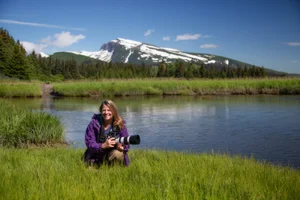
Week 15: Two Clear Days in Denali
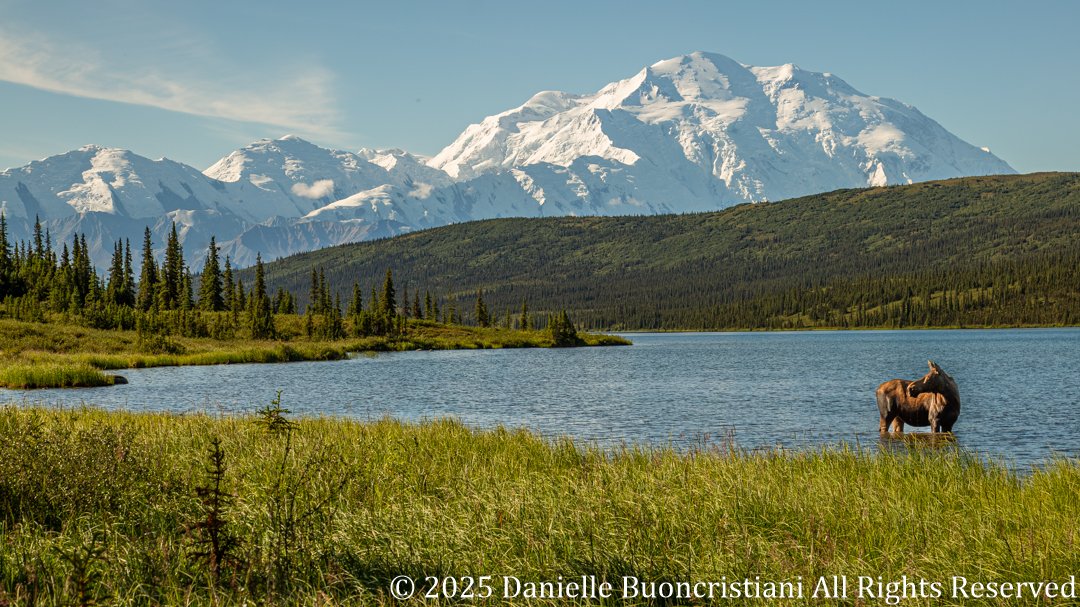
A female moose feeding in Wonder Lake, with Mount Denali rising behind her on our final morning in the park.
A Clear Day in Denali
After breakfast, we headed back out into Denali with clear skies holding — something that already felt rare. The park looked completely different under a clear blue sky. Mountains were visible in every direction, and for the first time, we could almost grasp their scale.
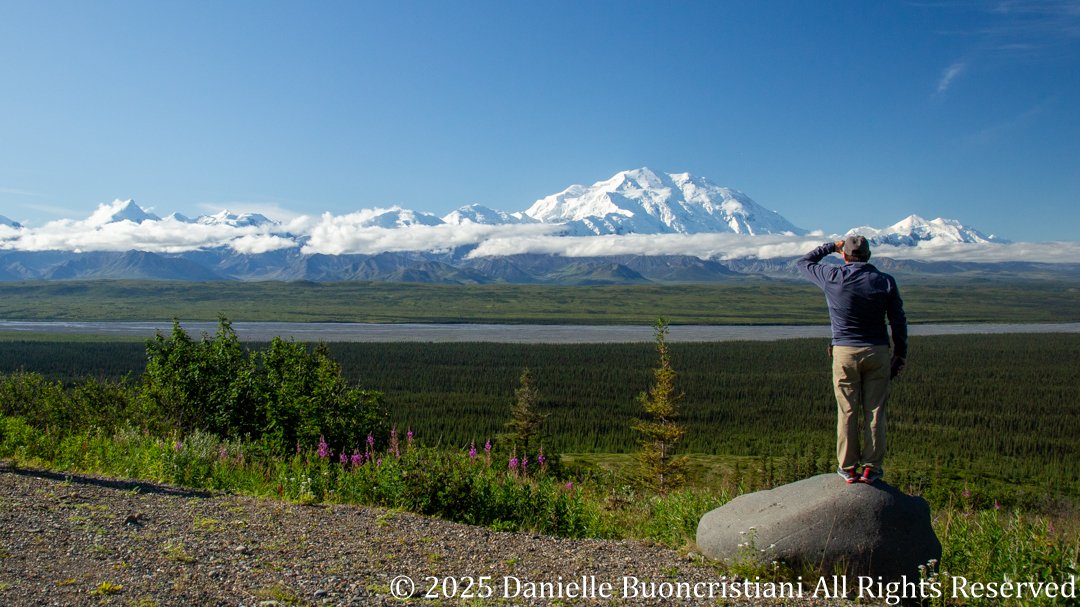
Dave taking in a clear view of Mount Denali after days of rain — a moment we didn’t take for granted.
We drove slowly, stopping often, photographing as the landscape opened up around us. Valleys stretched wider, ridgelines stacked into the distance, and glacial cuts in the terrain became easier to read in the clear light. After days of rain and limited visibility, it felt good to finally see the park this way.
We were still scanning for wildlife the entire time — stopping, watching, waiting — but now the landscape demanded just as much attention. With the rain gone, the scenery felt newly available. Mountains, valleys, and open tundra stretched out in ways we hadn’t been able to see before.
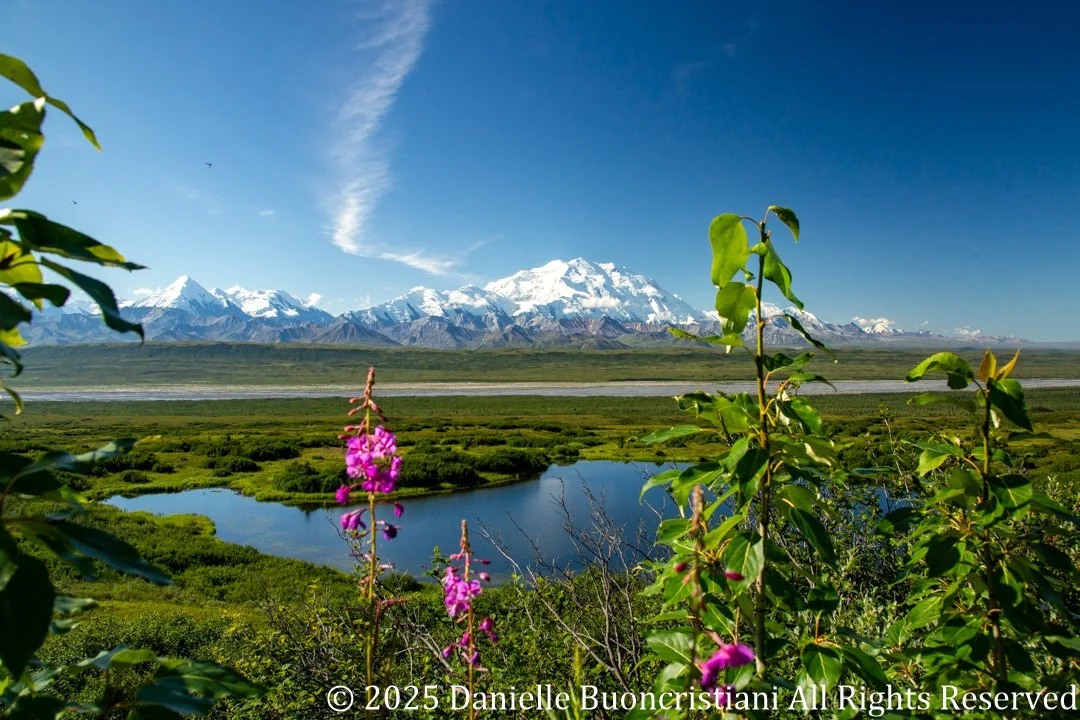
A kettle pond tucked into the tundra, with Mount Denali visible beyond — one of many quiet stops as we explored the park under clear skies.
As we moved through the park, conversations with our naturalist continued quietly — observations and explanations shared as we drove, stopped, photographed, and moved on. It wasn’t a formal lesson, just the kind of learning that happens when you’re out in the field long enough for questions to come naturally.
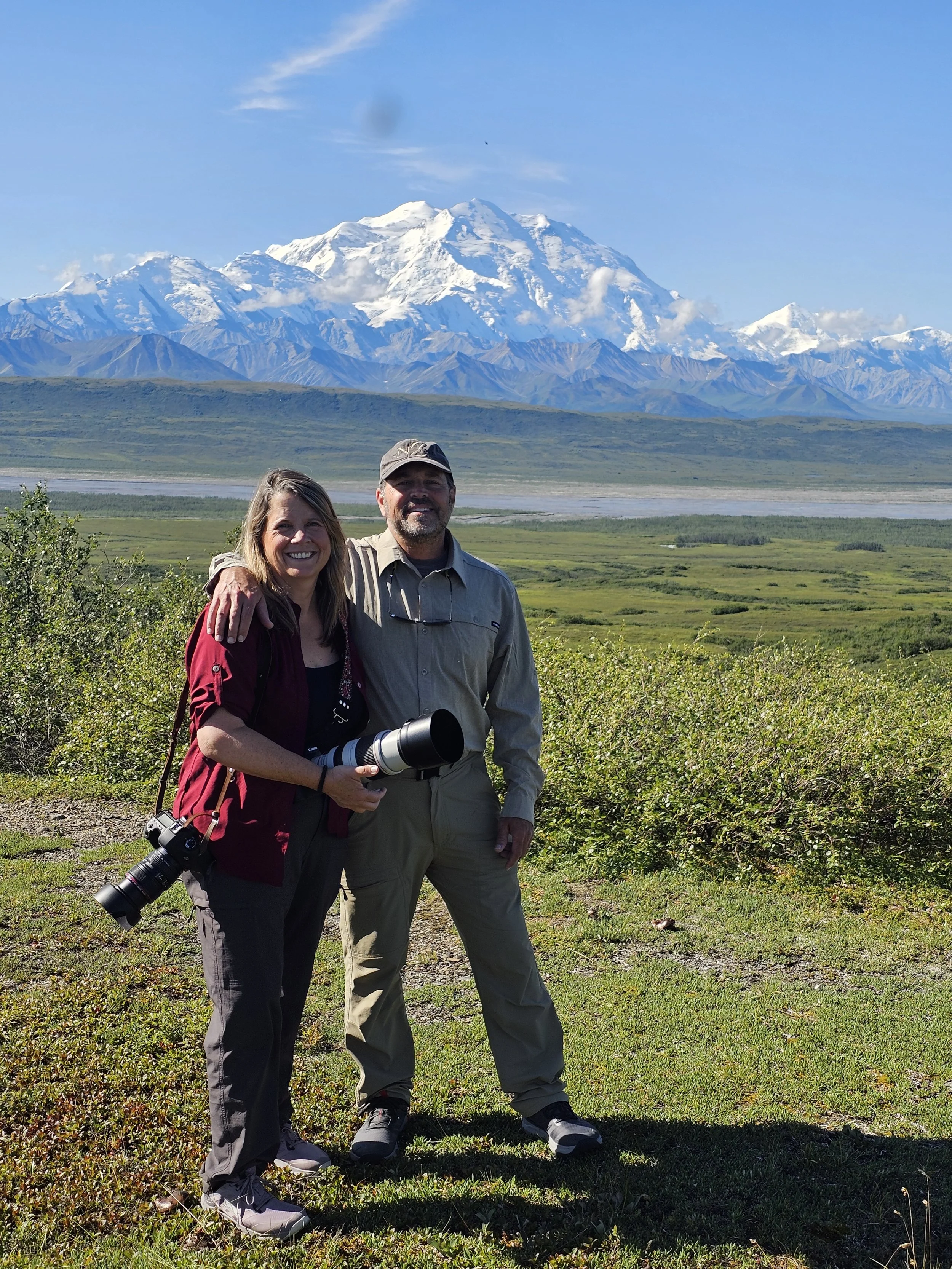
A photo together before moving on — cameras in hand, with Denali behind us.
Small Life, Big Adaptations
As we continued photographing the landscape, Wayde stepped down into the grasses, crouched for a moment, and came back holding something small in his hand — a wood frog.
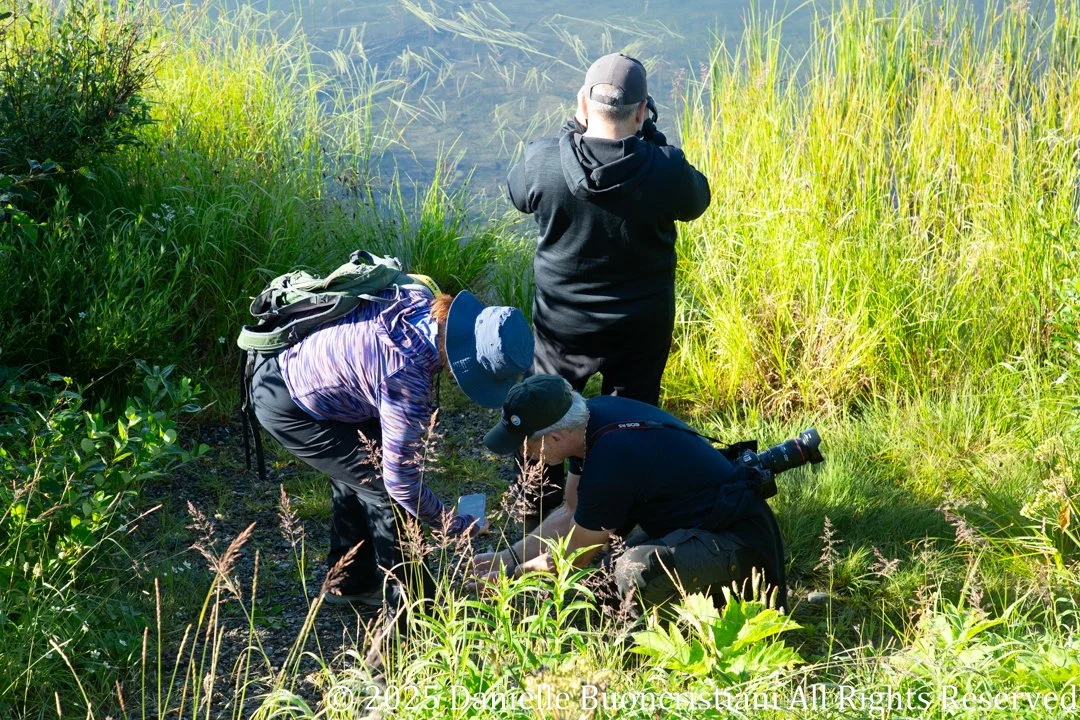
A pause along the road turned into a lesson when Wayde stepped into the grasses and found a wood frog near a kettle pond.
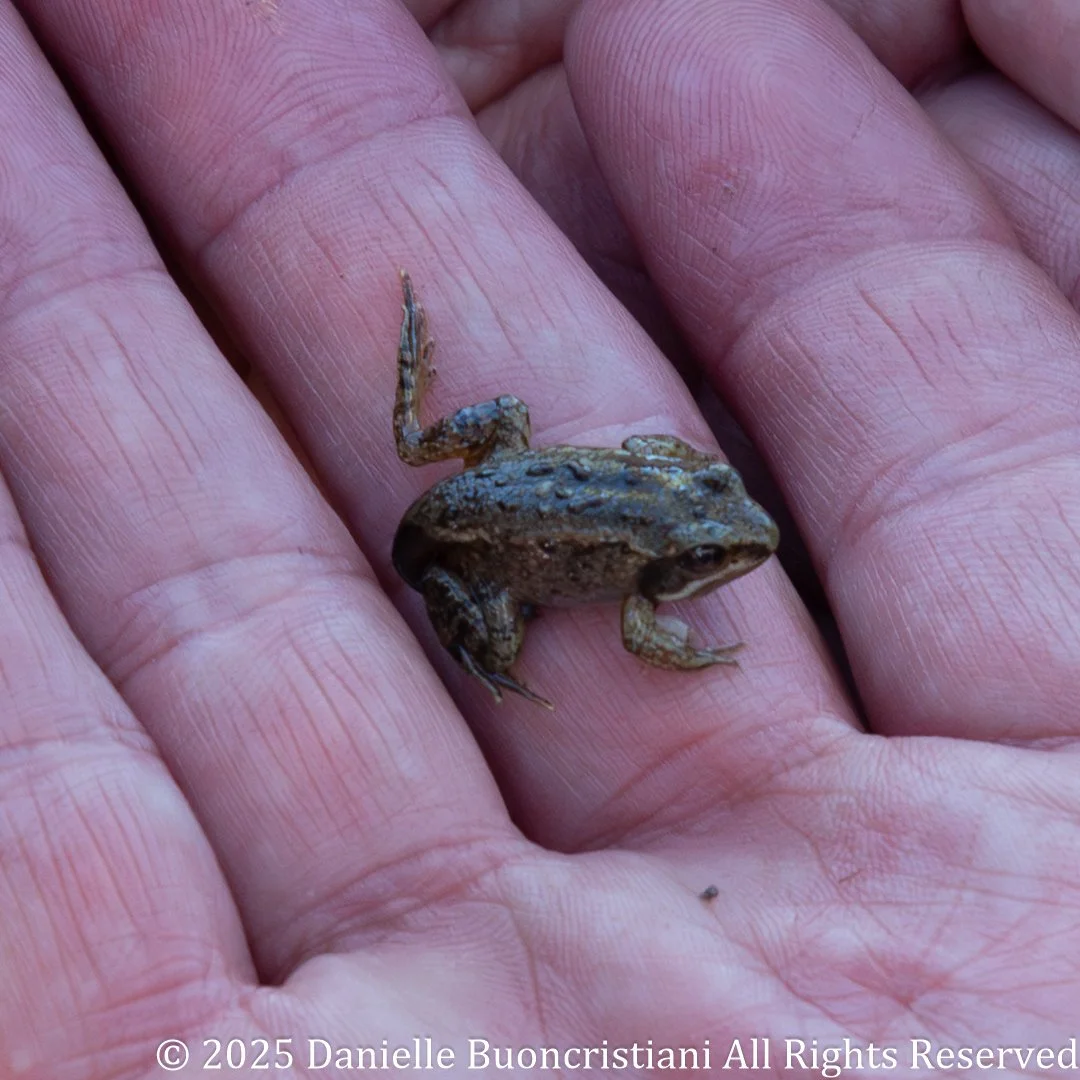
A wood frog, photographed up close — small, unassuming, and remarkably adapted to life in Alaska.
It was an easy thing to miss if you weren’t looking closely. We gathered around while he explained how this frog survives Alaska’s winters. Seeing it up close made the information tangible — not a sign or a statistic, just a living example of how animals here adapt to extreme conditions.
Field Notes: The Wood Frog
The wood frog is the only frog in Alaska known to survive whole-body freezing during winter.
During the coldest months, much of its body freezes — including its heart stopping and breathing ceasing.
Glucose in the frog’s body acts as a natural antifreeze, protecting cells from damage.
When temperatures rise in spring, the frog thaws and resumes normal activity.
Kettle Ponds and Caribou on the Move
As we moved deeper into the park, we stopped near a series of kettle ponds — shallow, rounded lakes scattered across the tundra, many of them edged with grasses and low vegetation. These ponds were everywhere, and nearly every one seemed to be active with life.
At one of the ponds, we watched a caribou run hard along the water’s edge, splashing through the shallows at full speed before disappearing back into the tundra. It happened quickly, but it was one of those moments where everything lined up — movement, light, and timing — and we were able to capture it as it unfolded.
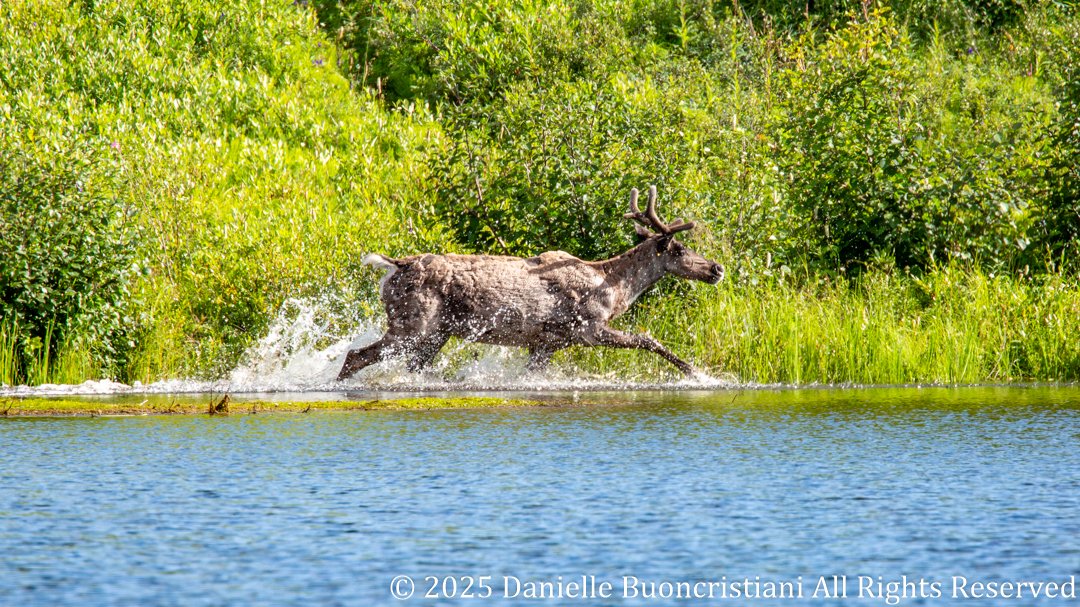
A caribou breaks into a full run along the edge of a kettle pond, splashing through the shallows before disappearing into the tundra.
Caribou sightings in Denali are often brief, and this was no exception. There was no pause, no lingering. Just a fast, powerful burst of motion across the landscape before it was gone again.
Field Notes: Caribou and Changing Winters
• Caribou do not hibernate. They remain active throughout the winter.
• They forage primarily on lichen buried beneath the snow.
• Using their wide hooves, they dig through snow to reach food — a behavior known as cratering.
• Warmer winters are bringing more frequent freeze–thaw cycles.
• When snow melts and refreezes, it forms hard ice layers that make food more difficult to access.
• Increased energy spent digging can reduce body condition and calf survival, contributing to population stress in some herds.
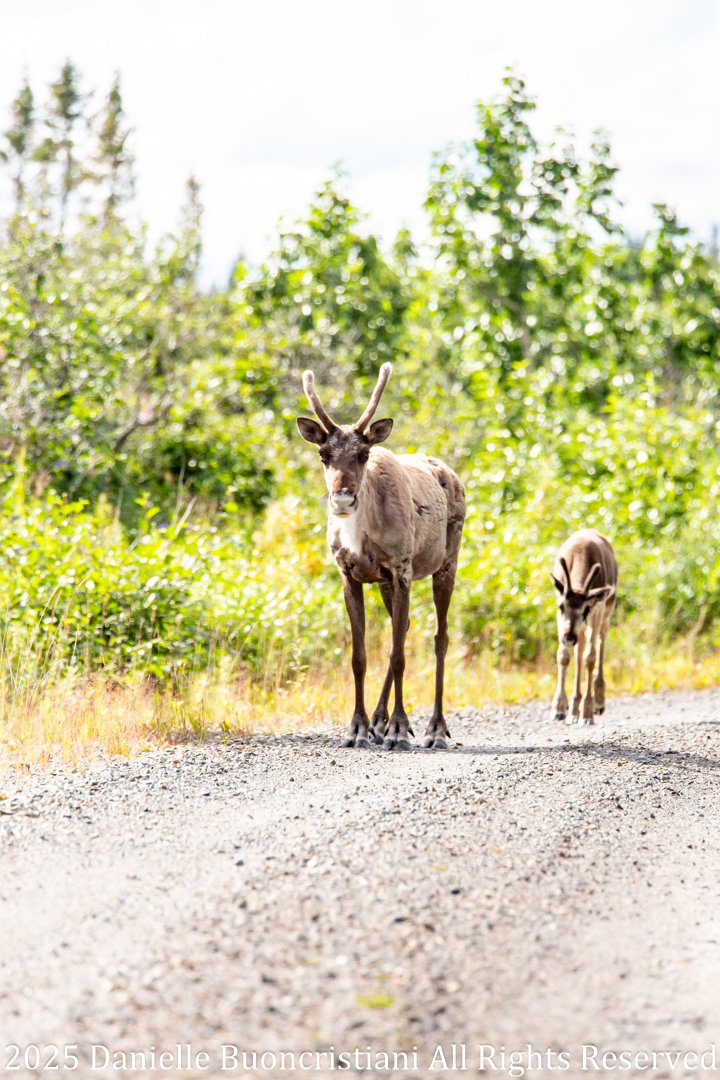
A mother caribou and her calf moving along the park road. With so little vehicle traffic due to the road closure, the caribou use the road as an easy way to travel through the landscape.
We spent time talking with our naturalist about what we were seeing — not just the animals themselves, but the conditions shaping their lives. Climate change came up often throughout the day, not as an abstract concept, but as something visible on the ground: changes in snowpack, vegetation, water patterns, and how animals move and feed through the seasons.
What stood out most was how closely everything was connected. The ponds, the tundra, the animals moving through it — all of it responding to changes that are already underway.
Field Notes: Kettle Ponds
Kettle ponds form when blocks of glacial ice are left behind as glaciers retreat.
As the ice melts, shallow depressions fill with water.
In Denali, kettle ponds support grasses, aquatic plants, insects, birds, and mammals.
Many kettle ponds contain beaver lodges, as warming temperatures and expanding vegetation have allowed beavers to move farther north.
Climate Change on the Ground
At this point, climate change isn’t theoretical — it is visible.
Our naturalist pointed out how Denali’s park road, built over permafrost, is increasingly unstable as that frozen ground thaws. In some areas the damage is subtle; in others, like the Pretty Rocks landslide, it forced a long-term closure of the park road beyond Mile 43 while a bridge and stabilization project are underway.
We saw similar signs throughout the landscape: shifting drainage patterns, expanding shrubs across the tundra, increased beaver activity around kettle ponds. None of it felt dramatic on its own. But taken together, it revealed how quickly this ecosystem is shifting.
These weren’t future projections. They were changes already shaping how the park functions — for visitors, wildlife, and the land itself.
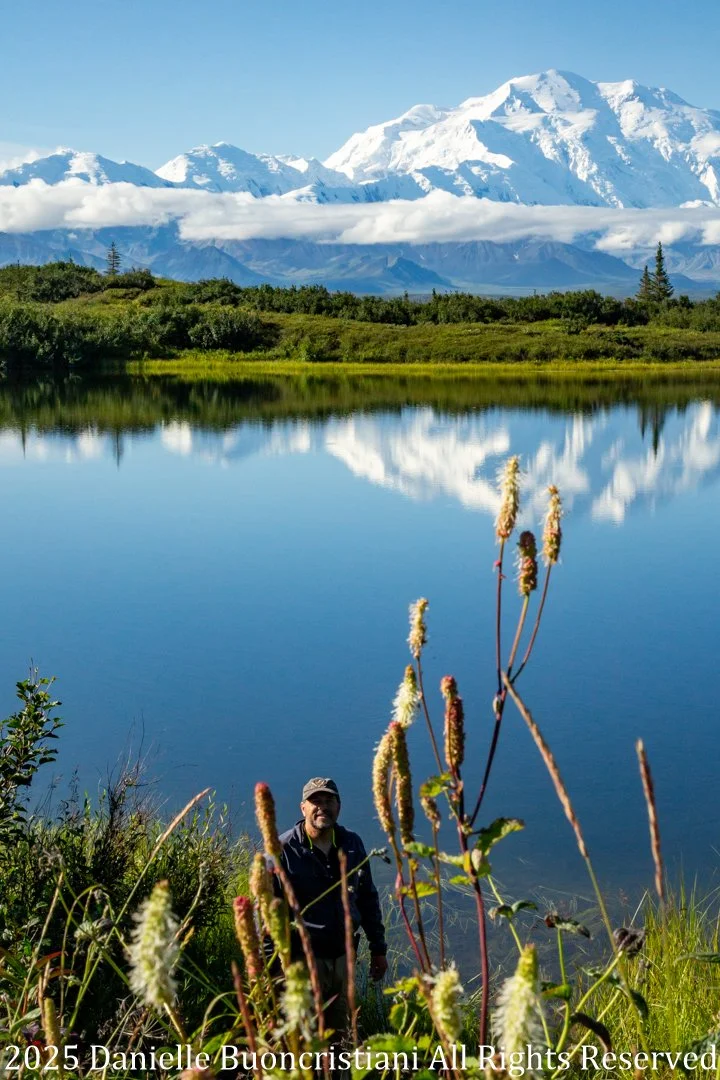
Dave near a kettle pond, framed by tundra plants, with Denali visible across the water.
The Last Morning at Camp Denali
Our last morning at Camp Denali began early, but not at dawn. We were up by 7 a.m., packing our bags and placing them outside the cabin door so staff could load the plane. After breakfast, we knew we had a few final hours to explore before flying out.
The skies were clear again. The mountain was still out. It felt like we’d been given one more chance.
We didn’t travel far. At Wonder Lake, we spotted a female moose near the shoreline. At first, she stayed close to the tundra, and we took a few photographs, assuming that would be it. Then she stepped into the lake.
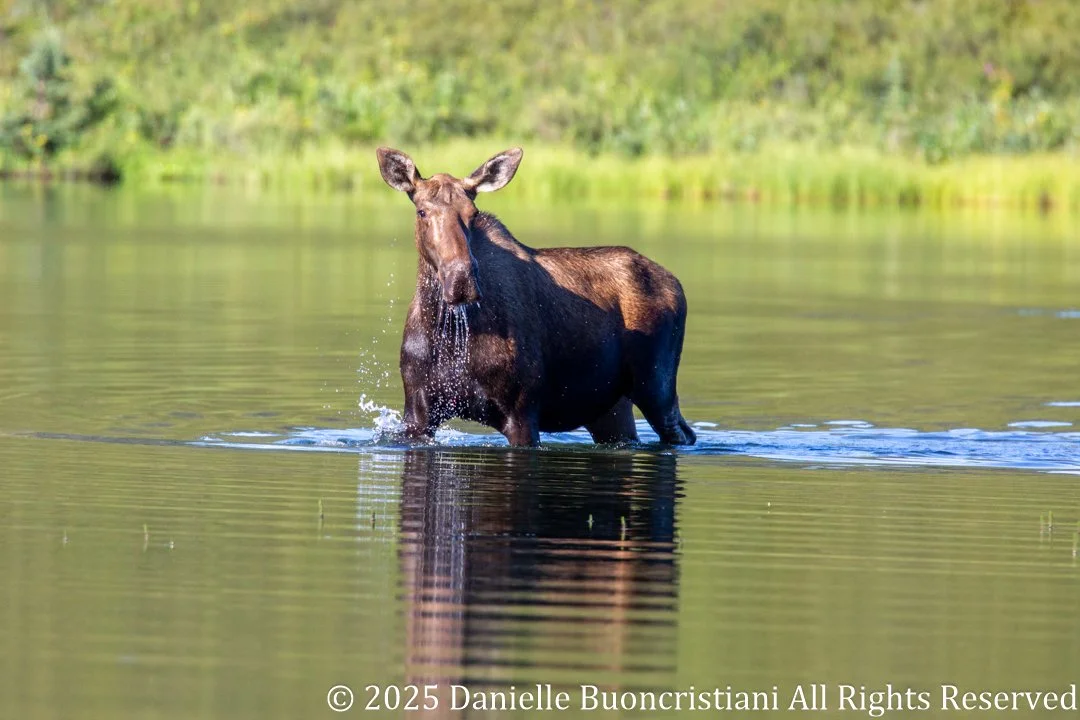
A cow moose feeding in Wonder Lake, moving slowly through shallow water while pulling up aquatic plants.
I hadn’t realized how shallow the water was — or maybe it was just how tall she was — but she moved easily, walking farther out while feeding on the grasses beneath the surface. With each bite, water poured off her face and shoulders as she pulled greenery up from below.
Moose regularly feed in shallow lakes like Wonder Lake, where aquatic plants are an important summer food source.
As we watched, it became clear that she was heading out across the lake — with Denali fully visible behind her.
We knew there was a small dock on the opposite side that could give us a better angle, so we circled around, and walked out quietly. From there, the scene unfolded slowly and calmly. The moose continued feeding, completely unbothered by us, while the mountain held steady in the background.
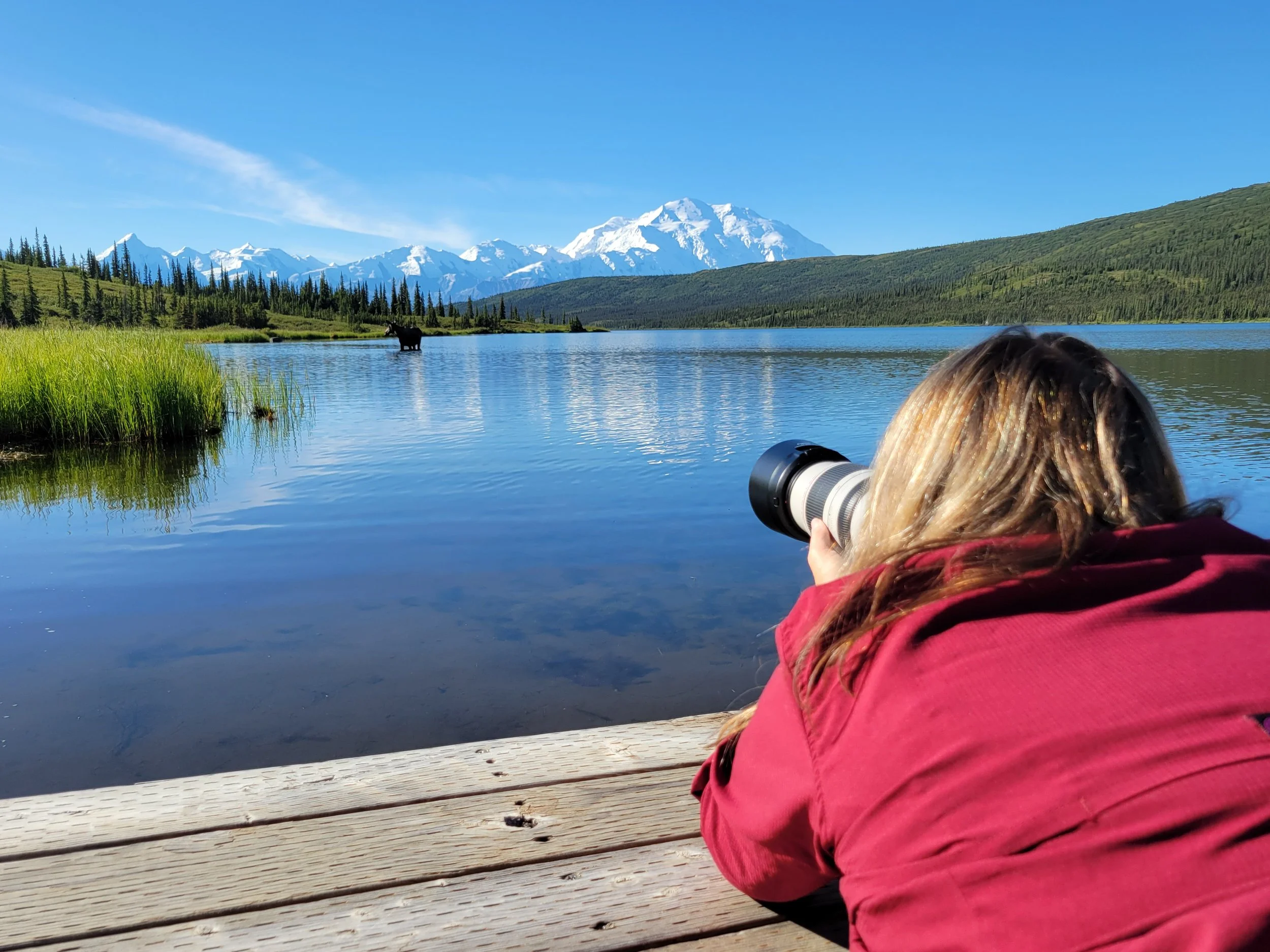
Photographing a cow moose in Wonder Lake, with Denali rising behind her.
I photographed from multiple angles, eventually lying flat on the dock to bring the grasses into the foreground as she moved through the water. The naturalist kept a quiet eye on distance, letting us know when we were fine and when it might be time to move. There was room to adjust settings, try different shutter speeds, and also to stop and simply watch.
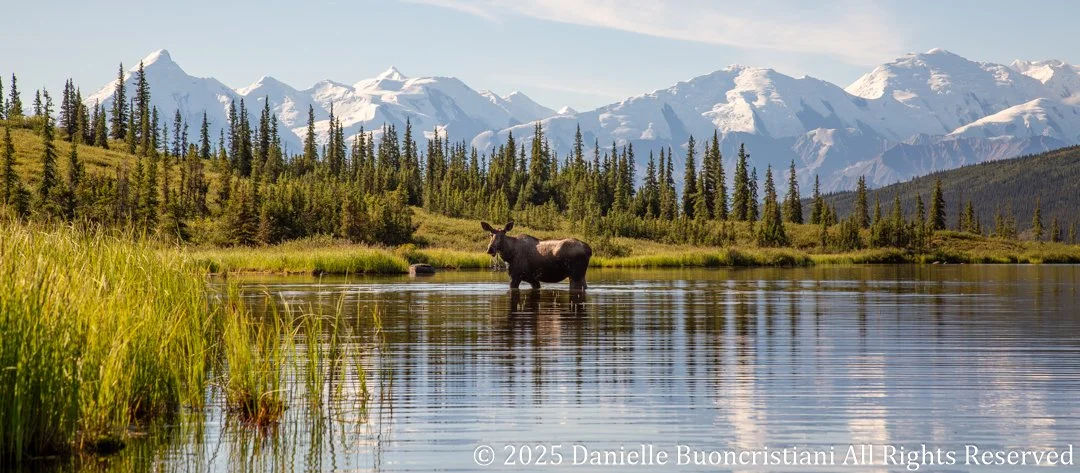
A cow moose feeding in Wonder Lake, with Denali and the Alaska Range behind her.
When the moose began moving closer, we stepped back. Hard to leave — but the right moment had passed.
We spent our final hour moving between kettle ponds, spotting beavers and scanning for wildlife one last time before returning to camp. Clear weather held for our flight out, giving us sweeping views of the mountains and glaciers below. From the air, Denali’s scale felt even more apparent — layered ridges, debris-darkened ice, and the Muldrow Glacier cutting through the landscape.
Leaving Denali by small plane, with a final look at the mountains and glaciers that shaped the days we spent there.
Field Notes: Muldrow Glacier
The Muldrow Glacier is one of the longest glaciers in Denali National Park.
It is known for periodic surge events, when the ice accelerates after long periods of slow movement.
During its most recent surge (2019–2020), sections of the glacier moved rapidly, carrying large amounts of rock and debris along its surface.
The dark appearance of the ice comes from this debris, showing how glaciers actively reshape the landscape as they move.
Then came the long drive south. Denali to Anchorage. Anchorage to Seward. The weather shifted fast — rain, darkness, and heavy skies — a sharp contrast to the clarity we’d just left behind. We arrived after midnight, tired but safe.
Denali was behind us.
Kenai Fjords was next.